What’s in My EDC Kit: Gun, Light, Knife, and Medical Gear
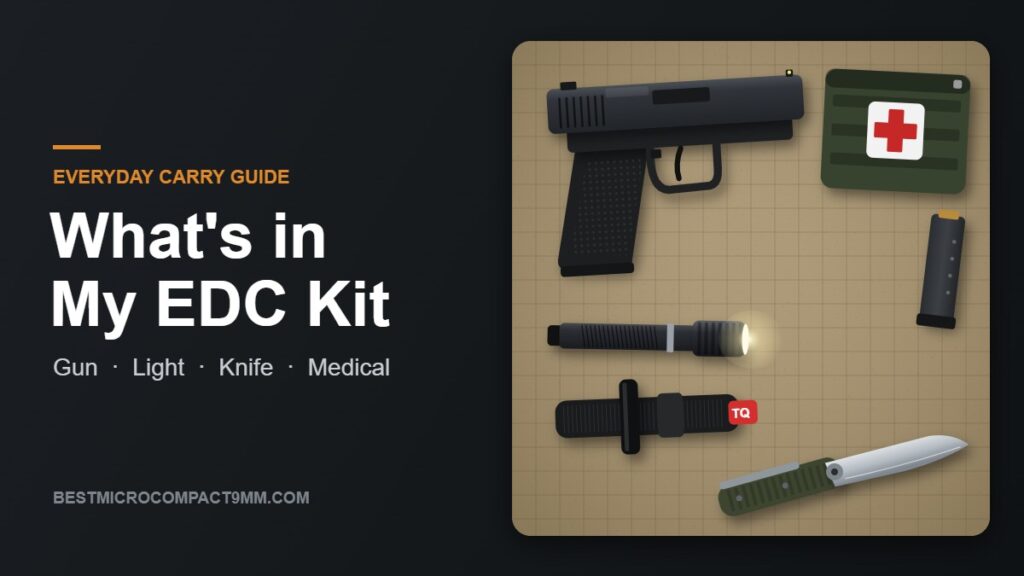
Ask ten concealed carriers what is in their everyday carry (EDC) kit and you will get ten different answers. Some carry a gun and a phone and call it good. Others leave the house with enough gear to outfit a small patrol. Most of us land somewhere in the middle, and the right answer depends on how you live, what you wear and what you are realistically likely to face.
Here is what’s in my EDC kit, built around four core items: a gun, a light, a knife and medical gear. For each one I will explain what I carry, why it earns a spot, and what to look for if you are building your own kit. None of it is exotic or expensive, and all of it disappears under normal clothes.
My EDC Kit at a Glance
| Item | What I Carry | Why It Earns Its Spot |
|---|---|---|
| Gun | Micro-compact 9mm with a red dot, in an appendix IWB holster | Serious defensive capability in a package small enough to carry every day |
| Spare magazine | One spare in a mag carrier on the support side | Fixes magazine-related malfunctions and adds reserve ammo |
| Flashlight | Compact handheld light, roughly 500 to 1,000 lumens, tail switch | Most threats happen in low light, and you need to see what you are dealing with |
| Knife | Folding knife with a 3-inch blade and pocket clip | The tool you will use most often, every single day |
| Medical | Tourniquet plus a compact bleeding-control kit | You are far more likely to face a serious injury than a gunfight |
| Everyday basics | Phone, wallet, carry permit and ID, keys | Communication, identification and legal requirements |
1. The Gun: A Micro-Compact 9mm
The center of any armed EDC kit is a pistol you will actually carry every day. For most people, that means a micro-compact 9mm. Guns like the SIG Sauer P365, Springfield Armory Hellcat, Smith & Wesson M&P9 Shield Plus and Glock 43X give you 10 to 15 rounds of 9mm in a package about the size of the old single-stack pocket nines. That combination of capacity and concealability is why this class of pistol dominates the carry market.
What I look for in a carry gun
- Reliability first. It must run with my carry ammunition, every time. I test any new carry gun with several hundred rounds, including at least a couple of hundred of the exact defensive load I plan to carry, before I trust it.
- A size I will not leave at home. The best carry gun is the one that is on you. A gun that is too big or heavy tends to stay in the safe on hot days.
- Good sights or an optic. I run a small red dot because it makes fast, accurate shots easier, especially at speed and in low light. If you are on the fence, read our breakdown of whether a red dot is worth it on your carry gun.
- Controls I can run under stress. Magazine release, slide stop and, if present, the manual safety should be easy for me to operate without shifting my grip.
If you are still shopping, start with our guide to the best concealed carry guns in 2026.
The holster matters as much as the gun
A quality holster is not optional. Mine is a rigid Kydex appendix inside-the-waistband (AIWB) holster with a claw to tuck the grip in and a wedge for comfort. Whatever style you choose, it must fully cover the trigger guard, hold the gun securely, stay open when the gun is out so you can reholster with one hand, and attach to a sturdy gun belt. See our picks for the best IWB holsters of 2026.
Spare magazine and ammunition
I carry one spare magazine on my support side. Many people think of a spare mag as extra capacity, but its more important job is fixing problems. Magazines are one of the most common causes of semi-auto pistol malfunctions, and a fresh magazine is often the fastest fix. For ammunition, I carry a quality jacketed hollow point from a major manufacturer, the same load I have tested in that specific gun.
2. The Light: See What You Are Dealing With
If I could only add one item to the gun, it would be a flashlight. A large share of violent encounters happen in low light, at night, in parking garages, or in dim buildings. Before you can make a sound decision about using force, you need to identify what you are looking at. Is that a threat, or a neighbor walking a dog? A good light answers that question.
Beyond defense, you will use a light constantly: finding something you dropped under the car seat, checking a noise outside, walking to your car, or getting around during a power outage.
What to look for in an EDC light
- Output: Somewhere around 300 to 1,000 lumens is plenty for EDC. More important than raw lumens is candela, which measures beam intensity and reach. A light with a tight, punchy beam lights up a face across a parking lot.
- Tail switch: A tactical-style tail button lets you activate the light instantly with your thumb, and momentary-on means it works while you hold the button down. Avoid lights that cycle through strobe and low modes before reaching high.
- Size: Pocket-sized, about 4 to 5 inches long, with a sturdy pocket clip.
- Power: Rechargeable lights are cheap to run and convenient. Lights that take CR123A batteries are great for long storage. Either way, keep it charged.
Why a handheld light if you have a weapon light? A weapon-mounted light is excellent, but you should never use the gun as a search tool. Every time you light up something with a weapon light, you point a gun at it. A handheld light lets you search and identify without pointing your muzzle at people you have not yet decided are threats.
3. The Knife: The Tool You Will Use Most
My knife comes out of my pocket more than anything else in my kit. Opening packages, cutting zip ties, trimming loose threads, cutting rope, opening blister packs, slicing an apple. A knife is primarily a utility tool, and that is the way I recommend thinking about it.
What I carry
A folding knife with a blade of about 3 inches, a deep-carry pocket clip and one-hand opening. A plain edge is easiest to sharpen and handles nearly every daily task. I clip it in my strong-side front pocket where I can reach it with either hand.
What to look for
- A legal blade length. Knife laws vary widely by state and city. Some places restrict blade length, assisted-opening or automatic knives, or certain blade styles. Check the rules where you live and travel.
- A good lock. A liner lock, frame lock or crossbar-style lock that will not close on your fingers during hard use.
- Quality steel. Mid-range steels hold an edge well and are easy to sharpen. You do not need an exotic super steel.
- A clip that keeps it secure. Deep-carry clips keep the knife low and discreet in the pocket.
A knife can be a defensive tool in a close-quarters struggle, but for most carriers it is a backup at best. If you want to use a knife defensively, get specific training. For everyday purposes, choose the knife that is most useful to you.
4. Medical Gear: The Most Likely Emergency
This is the part of the kit people skip most often, and the part I consider most important after the gun. The odds that you will witness a car crash, a workplace accident, a bad fall or a serious cut are far higher than the odds you will ever draw your gun. And if you ever do have to use your gun, you, a family member or an innocent bystander may be the one bleeding.
Severe bleeding from an arm or leg can kill in minutes, often before emergency services arrive. A tourniquet and basic bleeding-control supplies, plus the training to use them, can bridge that gap.
What I carry
- Tourniquet: A purpose-built tourniquet such as the CAT, SOF-T Wide or SAM XT, all of which are widely used and recommended by tactical medicine experts. I carry mine in a pocket or on the belt in a holder so it is quick to reach with either hand.
- Compression or pressure bandage: For wounds where a tourniquet is not appropriate, and to hold packing in place.
- Hemostatic or compressed gauze: For packing deep wounds in junctional areas such as the groin, armpit or neck, where a tourniquet will not work.
- Nitrile gloves: To protect yourself when helping someone else.
- Optional: A pair of chest seals and compact trauma shears, if your kit has the room.
All of the non-tourniquet items fit into a small pocket kit or an ankle-mounted trauma kit, which is my favorite way to carry medical gear because it works with any outfit and does not take up belt space.
Two important warnings
- Buy tourniquets from reputable sources. The market is full of counterfeit and cheap knockoff tourniquets that can break under pressure. Buy from the manufacturer or authorized dealers, and avoid suspiciously cheap listings.
- Get trained. Medical gear is only useful if you know how to use it. A free or low-cost Stop the Bleed course covers tourniquet use, wound packing and pressure in a couple of hours. Practice applying your tourniquet to yourself, one-handed, on both arms and legs.
Supporting Gear: The Rest of My Pockets
- Phone: The most important emergency tool you own. Keep it charged, and know how to quickly call 911 and share your location.
- Carry permit and ID: Many states require you to carry your permit whenever you carry a gun, and some require you to inform an officer during a stop. Know your state’s rules.
- Wallet and keys: Kept slim and organized so they do not crowd the pockets that hold your light and knife.
- Pepper spray (optional): A useful less-lethal option for situations that do not justify deadly force. Check your state’s laws on size and formulation.
- Pen and a watch (optional): Small things that are handy every day.
How I Carry It All
Organization matters. Every item should live in the same place every day so you can find it without looking, and so your gear does not interfere with your draw. Here is my layout as a right-handed carrier:
- Gun: Appendix IWB, about the 1 o’clock position.
- Spare magazine: IWB on the left side, around 10 to 11 o’clock, bullets facing forward.
- Light: Left front pocket, clipped so it comes out ready to use.
- Knife: Right front pocket, clipped toward the back of the pocket so it does not block my hand.
- Tourniquet: Belt holder on the left side or a back pocket, reachable with either hand.
- Trauma kit: Ankle kit on my left leg.
- Phone and wallet: Left back pocket and right back pocket.
Adapt this to your own body type, clothing and job. Our guides on carrying at the office, gym or while driving and carry for bigger body types can help.
Building Your EDC Kit on a Budget
You do not need to buy everything at once. If you are starting from scratch, here is the order I would build it in:
- A reliable gun, a quality holster and a sturdy belt. Do not skimp on the holster and belt to buy a fancier gun.
- Training and practice ammunition. Gear without skill does not help. See how often you should practice.
- A genuine tourniquet and a Stop the Bleed class. Inexpensive and potentially lifesaving.
- A good handheld flashlight. Quality lights are surprisingly affordable now.
- A solid folding knife. Good mid-range knives cost far less than premium models and do the same job.
- A spare magazine and carrier, then a compact trauma kit.
- Upgrades: A red dot, pepper spray and other extras.
Common EDC Mistakes to Avoid
- Carrying gear you have never trained with. If you cannot use your tourniquet one-handed or draw your gun smoothly from concealment, practice first.
- Inconsistent placement. Moving gear around from day to day slows you down when it matters.
- Overloading your belt. Too much gear makes you uncomfortable, makes you print and tempts you to leave things at home.
- Cheap holsters and counterfeit tourniquets. These are the two places where saving money can get people hurt.
- Ignoring the law. Gun, knife and pepper spray laws vary from state to state and city to city. Know them before you carry.
- Neglecting maintenance. Charge your light, clean your gun, and rotate your carry ammo periodically.
For more pitfalls to avoid, read 10 mistakes new concealed carriers make.
Final Thoughts
A good EDC kit is not about carrying the most gear. It is about carrying the right gear for the problems you are most likely to face, and knowing how to use all of it. A reliable micro-compact 9mm in a quality holster, a bright handheld light, a useful folding knife and a real tourniquet cover a remarkable range of emergencies, and all of them fit under a T-shirt.
Start with the basics, train with everything you carry, and refine your kit over time. The best EDC setup is the one you carry every single day.
Frequently Asked Questions
What are the essential items in a concealed carry EDC kit?
For most people, the core items are a reliable handgun in a quality holster, a handheld flashlight, a knife, a tourniquet and a phone. A spare magazine and a compact bleeding-control kit are strongly recommended additions.
Do I really need a tourniquet if I carry a gun?
Yes. You are far more likely to encounter a serious bleeding injury from an accident than a defensive shooting, and if you ever are in a shooting, someone may need bleeding control immediately. A tourniquet is inexpensive, small and potentially lifesaving.
How many lumens does an EDC flashlight need?
Roughly 300 to 1,000 lumens is plenty for everyday carry. Beam intensity (candela), a tail switch and a size you will actually carry matter more than the highest lumen number.
Is it legal to carry a knife with my gun?
In many places, yes, but knife laws vary widely. Some states and cities restrict blade length or certain types of knives. Check your local and state laws, and the laws anywhere you travel.
Should I carry a spare magazine?
Yes, if you can. A spare magazine is the fastest fix for many malfunctions caused by a damaged or faulty magazine, and it gives you extra ammunition.